synopsis
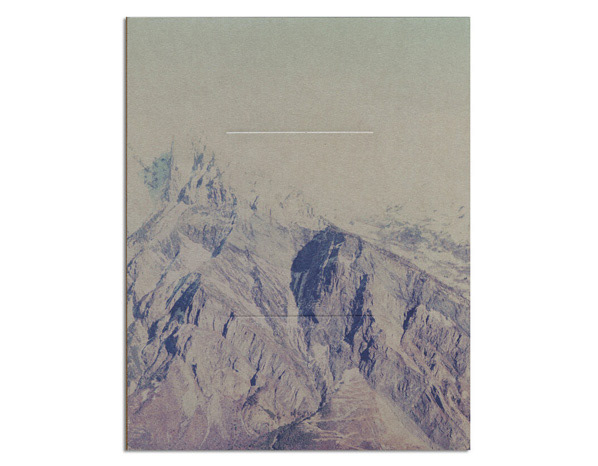
The Maurienne Valley in the French Alps presents a carefully managed and extensively developed landscape, marked by the ambiguities and contradictions inherited from its industrial history. The Arc River, which flows through it, was indeed conducive to the development of the aluminum industry, thanks to its capacity to power the factories with hydroelectricity. Nicknamed the "aluminum valley," it is bordered by a highway and soon by a high-speed rail line between Lyon and Turin, a project, however, tainted by suspicions of corruption and environmental damage. Despite a few winter sports resorts, most of the land in the Maurienne is essentially uninhabitable, evoking the romantic image of a pure and sublime nature.
In White Coal, a patient documentary work carried out in this region between 2016 and 2019, the young photographer Teo Becher combines two complementary image regimes. Faithful to a conception of photography inseparable from wandering within a defined space, he begins by physically experiencing the Maurienne landscape: being in the mountains, walking there, breathing there, as close as possible to the topography, to the point where this "uninhabitable" mountain becomes a central character in his book. In parallel, influenced by the thought of Philippe Descola, for whom nature is a cultural construct and therefore the difference between nature and culture is nonsense (Beyond Nature and Culture, 2005), and by the reflections on the Anthropocene of Donna J. Haraway, (Staying with the Trouble, 2016, published in French by Éditions des Mondes à faire, 2020), Teo Becher sought to photograph this moment where landscape and traces of human activity meet, in a relationship of interdependence rather than opposition.
Si ces deux pans du travail s’inscrivent avec évidence dans une tradition documentaire, ils en brouillent néanmoins les codes en acceptant le hasard et l’imperfection de la chimie argentique, emportant le lecteur dans un flottement onirique qui renforce cette interdépendance entre humain et paysage.
Enfin le livre est ponctué d’images presque abstraites, issues de films photographiques enterrés en différents endroits le long de la vallée de la Maurienne pour des durées allant de quelques semaines à deux ans. Ces photos sont imprimées sur des pages en partie non massicotées, de manière à les dissimuler, accentuant leur caractère mystérieux. L’ouvrage s’accompagne d’un court essai sur l’histoire de l’aluminium en Maurienne rédigé par Teo Becher.
Enfin le livre est ponctué d’images presque abstraites, issues de films photographiques enterrés en différents endroits le long de la vallée de la Maurienne pour des durées allant de quelques semaines à deux ans. Ces photos sont imprimées sur des pages en partie non massicotées, de manière à les dissimuler, accentuant leur caractère mystérieux. L’ouvrage s’accompagne d’un court essai sur l’histoire de l’aluminium en Maurienne rédigé par Teo Becher.
photos of the book
technical information
publisher : Le Bec en l'Air
2021
108 pages
50 photographs
dimensions : 24 x 30 cm
2021
108 pages
50 photographs
dimensions : 24 x 30 cm
about Téo Bécher
Born in Nancy in 1991, Téo Becher is a French photographer who graduated from the École supérieure des Arts visuels le Septante-Cinq in Brussels (2014) and holds a master's degree in photography from KASKA in Antwerp (2020). His work has been exhibited at the La Gacilly Festival in 2017, the Charleroi Museum of Photography in 2018, the Manifesto Festival in 2019, FoMu in Antwerp in 2020, and screened at Riga Photo Month in Latvia in 2020. His work, Charbon blanc, won the Caisse d’Épargne Prize at the L’image Satellite Festival in Nice in 2019, as well as the Maison Blanche Prize at the PhotoMarseille Festival in 2020. His images are part of the collections of the Charleroi Museum of Photography and FoMu in Antwerp.
find / buy the book
more information
Le blog de Fabien Ribery
book in my collection
publisher : Le Bec en l'Air
2021
108 pages
50 photographs
dimensions : 24 x 30 cm
Limited edition (20 copies) with signed digital color print,
18 x 24 cm, on Hahnemuhle Rag Satin 310 g paper.
2021
108 pages
50 photographs
dimensions : 24 x 30 cm
Limited edition (20 copies) with signed digital color print,
18 x 24 cm, on Hahnemuhle Rag Satin 310 g paper.